
updated regularly – latest review: October 2026
Slots
Online Casino Basics: How to Play Online Slots
Online video slots draw inspiration from physical slot machines — a long-standing fixture of pubs and casinos. In doing so, they combine the simple mechanics of old-school fruit machines with modern graphics and innovative features.
Slots are simple, luck-based games. Even so, they can overwhelm new players with jargon and special features. In general, most games follow a fairly similar structure, so once you learn the basics, you can pick up any slot quickly.
Online slots step-by-step
Before each spin, you make a few decisions that determine how much you bet.
1. Check the Pay Table Every slot has a pay table. Look at it before you play any new game. It lists all potential prizes, scatters, wilds, and bonus features.
2. Select the Number of Paylines Many slots offer multiple paylines (also called win lines). You can usually choose how many to bet on. Fewer paylines means cheaper spins, but you may miss out on the biggest prizes.
3. Select Coin Size Most video slots let you set how much each coin is worth in your currency. The options vary between games.
4. Select Bet Level As well as setting coin value, you can usually choose how many coins to bet per payline. On Starburst, for example, you can select between one and ten paylines, seven coin values (from £0.01 to £1.00), and one to ten coins per payline.
5. Click Spin Once you’ve set your bet, hit Spin. Outcomes are fully randomised, so there are no right or wrong choices during the game.
Key online slots terms
Most slots use three to five reels, each containing rows of symbols. Here are the main features to understand:
Paylines Paylines are winning combinations of matching symbols mapped across the reels. Most games have between 9 and 1,024 active paylines. You can often choose how many lines to play — more lines means higher stakes but more ways to win. Some games fix all lines automatically. Others replace paylines entirely with cluster-based wins, rewarding groups of adjacent matching symbols.
Wild Symbols Wilds act as jokers. In effect, they substitute for any missing symbol on a payline to complete a winning combination. Some games include Sticky Wilds or Expanding Wilds, giving players extra chances at bigger wins. In some games, a combination of wilds triggers a bonus or multiplier.
Scatter Symbols Scatters trigger bonus games. In most cases, you need to land three or more on a single spin to activate them. Several types of scatter can appear in one game. Check the paytable for full details — it’s always available from the game’s main menu.
Bonus Games Bonus games are unique to online slots. In particular, the most common format is a free spins round, where you receive a set number of risk-free spins, sometimes with multipliers attached. Land the required scatters and the bonus triggers automatically. Some games let you re-trigger free spins during the bonus round, and scatter combinations often unlock jackpots too.
Types of online slot games
5-Reel Slots — The most common type at online casinos. They feature five vertical columns, each usually showing three to four rows of symbols.
Video Slots — Slots that use a graphical interface rather than mechanical wheels. The term distinguishes modern, feature-rich games from Classic Slots, which replicate the look of traditional fruit machines.
Free Spins — Free turns awarded either as an in-game bonus feature or as a promotional offer from the casino to attract new players.
Random Number Generator (RNG) — Software that determines the outcome of every spin. RNGs ensure each result is truly random and that payout percentages match advertised figures.
Multipliers — Features that multiply your winnings by a set amount. They activate during bonus rounds and often unlock a game’s biggest prizes.
Evaluating online slots
Slots are games of chance. Two pieces of information help you compare games before you play:
Payout Percentage (RTP) Online slots typically pay out between 92% and 97% over time. This figure represents the house edge — the higher the RTP, the better the odds for players. Since luck drives outcomes in slots, choosing a high-RTP game is one of the few practical decisions you can make.
Variance / Volatility Two games with the same RTP can feel very different depending on variance. A low-volatility slot pays out small wins regularly and costs less along the way. A high-volatility slot burns through your balance faster but pays out larger amounts when it does hit. Most casual players are better off with low-variance games, even if the potential wins are smaller.
Roulette
Beginner's guide to playing Roulette
Every spin of the roulette wheel brings the chance of big returns — up to 36x your stake for a single number win.
Roulette suits beginners better than games like blackjack or poker because it requires no prior knowledge. You pick a number, place your bet, and wait. If the ball lands on your number, you win.
More experienced players spread their bets across different combinations and formats. But the principle stays the same — the ball determines the outcome, regardless of skill level.
At its core, roulette is pure probability.
How the wheel works
A standard European roulette wheel has 37 pockets — numbers 1 to 36 alternating red and black, plus a green zero. Each number has an equal chance of winning on any given spin. Pick a single number and your odds are 1 in 37. Pick a dozen, and your odds rise to roughly 1 in 3, minus the house edge from the zero.
Players have no control over where the ball lands. Understanding the available bets and their payouts is where strategy comes in.
How to play: step by step
Start with our Free Play Roulette to get comfortable with the software before betting real money.
- Your balance appears as chips at the bottom of the screen — select a denomination to activate it.
- Click anywhere on the table to place your bet — inside or outside. Repeat the click to add more chips to the same position.
- Add further bets across different positions if you wish.
- Click Spin to set the wheel in motion.
- Wins pay out automatically and a new round begins.
The interface is straightforward across most digital versions of the game.
The Roulette Wheel and Table
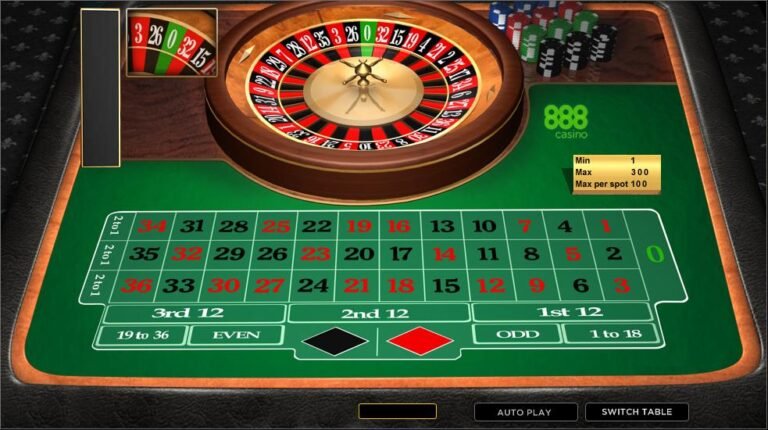
The Wheel A European roulette wheel has 37 pockets — 36 numbered slots (1–36) in red and black, plus one green zero. Numbers are arranged to distribute low, high, odd, and even values evenly. The American version adds a second green pocket (double zero), increasing the house edge.
The Table The main section of the table shows numbered spaces matching the wheel. Bets placed here are inside bets. The area below the numbered grid is for outside bets, which carry lower risk and lower payouts.
From right to left, outside betting options include: three dozens (1st 12, 2nd 12, 3rd 12), low/high (1–18 and 19–36), odd/even, and red/black. Column bets run along the left side, and a separate space covers the zero.
Betting in Roulette
| Bet | Payout | Description |
|---|---|---|
| Single / Straight | 35:1 | One number. Win if the ball lands on it. |
| Split | 17:1 | Two neighbouring numbers. Win if either comes up. |
| Street | 11:1 | Any three numbers in a horizontal row. |
| Square | 8:1 | Any four numbers in a square formation. |
| Double Street | 5:1 | Six numbers across two horizontal rows. |
| Trio | 11:1 | Three numbers including one or more zeros. |
| Top Line | 6:1 | 0, 00, 1, 2 and 3 combined. |
| Low / High | 1:1 | Numbers 1–18 or 19–36. Zeros excluded. |
| Red / Black | 1:1 | Colour bet. Zeros excluded. |
| Odd / Even | 1:1 | Odd or even numbers. Zeros excluded. |
| Any Dozen | 2:1 | First, second or third group of 12 numbers. |
| Column | 2:1 | First, second or third column of numbers. |
As you gain experience, understanding these bet types gives you more tools to shape your roulette sessions.
Blackjack
How the game works
Each player receives two cards from the dealer. The goal is to build a hand closer to 21 than the dealer — without going over.
- Cards 2–10 are worth their face value
- Face cards (Jack, Queen, King) are worth 10
- Aces are worth 1 or 11, depending on your hand
On each turn, you choose to hit (take another card) or stand (keep your current total). In that case, going over 21 means you bust — an automatic loss. If you tie with the dealer, the bet pushes and you get your stake back.
Blackjack is an Ace plus any face card dealt in your opening hand. As such, it beats every other hand except another blackjack. Some game versions also reward a 7 Card Charlie — seven cards totalling exactly 21 — which beats a standard 21.
In addition, depending on the version, you may split pairs into two separate hands or take additional side bets.
Blackjack strategy
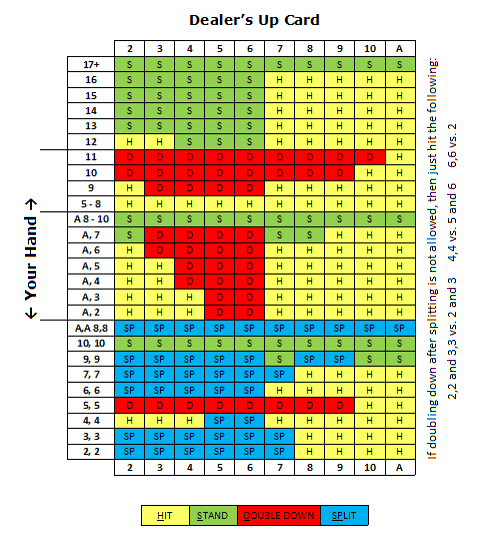
Blackjack has 340 possible hand combinations. Around 100 have obvious next moves — two 6s means you hit, for example. Good strategy focuses on the remaining 240 hands.
Here are the key principles to reduce the house edge:
Don’t rush to bust when the dealer is weak If the dealer shows a low card, they may go over 21 themselves. A low standing hand still beats a busted dealer — don’t eliminate yourself unnecessarily.
Ace & 6: Hit. Ace & 7: Stand With Ace & 6, you sit at a soft 17. Hit — the Ace reverts to 1 if you’d otherwise bust, so you can only improve. With Ace & 7, you’re at a solid 18. The bust risk on the next card is too high to justify hitting.
Split 8s and Aces — Two Aces gives you a hand of 12 — weak. Splitting them gives you two chances at strong hands. Meanwhile, two 8s leaves you on 16 — one of the hardest hands in the game. Two independent hands of 8 are far more manageable than playing 16 straight.
Not sure which move to make? Try our Blackjack Strategy Calculator to see the best play for any hand, and watch our video guide to the calculator to learn how to use it. You can also practise risk-free with our free Blackjack game.
Advanced Blackjack strategy tips
Surrender rarely Surrender lets you fold and recover half your stake. It’s seldom available, and even when it is, few situations justify using it.
Double down wisely Doubling your bet commits you to one more card and then standing. Use it when the dealer shows a weak hand and yours has strong potential without bust risk.
Avoid Insurance Insurance increases the house edge relative to its payout. It’s not a good bet — skip it every time.
Stand at 17 Hitting from 17 busts more often than it helps. Mathematically, standing at 17 is the right play across the long run.
Blackjack Glossary
Blackjack — An Ace plus a face card in your opening hand. An unbeatable hand, also called a natural.
Bust — Going over 21. An automatic loss.
Double Down — Doubling your bet in exchange for exactly one more card. You must stand after taking it.
Hard Hand — A hand with no Ace, or one where the Ace counts as 1.
Hit — Taking another card.
Hole Card — The dealer’s second card, kept face down until the player finishes their turn.
Insurance — A side bet worth half your original stake, available when the dealer shows an Ace. Pays out if the dealer has blackjack.
Push — A tie between player and dealer. Stakes are returned.
Soft Hand — A hand containing an Ace valued at 11. You cannot bust on the next card.
Split — Dividing a pair into two separate hands, each with its own bet.
Stand — Keeping your current hand and taking no more cards.
Surrender — Folding your hand in exchange for half your stake back.
Up Card — The dealer’s face-up card, visible from the start of the hand.

Casino loyalty
Loyalty and VIP programmes
Most UK casino sites offer loyalty programmes. Not all of them deliver equal value — some schemes are genuinely rewarding, while others look better on paper than they perform in practice. Understanding how they work helps you decide whether to engage with them.
What are loyalty programmes?
A casino loyalty programme works like any other reward scheme. Spend money and earn points. In turn, those points convert into bonuses, credits, or other perks.
A typical structure looks like this:
- Wager £X to earn Y loyalty points
- Use Y points to claim Z bonus credits
Operators add multipliers, points boosts, and loyalty tiers to differentiate their schemes. Overall, whatever the format, the core principle is the same: the more you wager, the more you earn. Consistency drives rewards — not occasional big spins.
How do casino loyalty schemes work?
Here’s a practical example:
Earn 5 loyalty points for every £10 wagered
Not all games contribute equally. Casinos apply weighting to different game types, which affects how quickly your bets count toward the target:
- 100% weighting — Slots, American Roulette, Parlour Games
- 50% weighting — Table Poker, most Roulette variants, Sic Bo
- 10% weighting — Video Poker, most Blackjack, Craps, Baccarat
- 2% weighting — Classic Blackjack, All Aces Video Poker
If you play table poker at 50% weighting, you need to stake £20 to count as £10 toward the target.
Once you reach 5,000 points, you can exchange them for £10 in casino credits — subject to a 30x wagering requirement. To reach 5,000 points, you would need to wager £10,000.
That sounds steep. But loyalty tiers soften the climb. Reaching the second tier (Silver) typically brings a 25% points boost, reducing the effective target.
One important distinction: wagering refers to money staked, not money lost. You could wager £10,000, win £10,100, claim your cashback, and walk away in profit.
What Are VIP programmes?
Some casinos run invite-only VIP programmes alongside — or above — their standard loyalty tiers. These target high-volume players and offer more personalised rewards.
Typical VIP benefits include:
- Points boosts
- Personalised reload bonuses
- Free bets
- Enhanced cashback rates
- Dedicated VIP account manager
- Invitations to exclusive events
There are no published thresholds for invite-only schemes. Casinos use internal data to identify eligible players.
Should you play the loyalty game?
For casual or low-stakes players, loyalty schemes are unlikely to make a meaningful difference. That said, you don’t need to do anything to join — casinos track bets automatically and assign points accordingly.
Think of loyalty rewards as a background bonus. In other words, moving up a tier is a nice outcome
For most players, weekly promotions — reload bonuses, free spins — deliver better short-term value. High-volume players are the ones who benefit most from focusing on loyalty rewards.

Wagering
Why Casinos Use Wagering Requirements
Casino bonuses always come with conditions. Handing out free money with no strings would be unsustainable, and an open invitation to abuse. Wagering requirements are the mechanism casinos use to protect themselves — and they’re standard practice across the UK industry.
That said, the rules around wagering requirements changed significantly on 19 January 2026, when new UKGC regulations came into force. UK players now have much stronger protections than before.
What are wagering requirements?
A wagering requirement sets the number of times you must bet a bonus amount before you can withdraw any winnings from it. Some requirements apply to the bonus alone. Others apply to the combined total of your deposit plus bonus — a key distinction that significantly affects how much you need to wager.
Example: ACE Casino offers a 200% match on your first deposit up to £25. You deposit £25 and receive a £50 bonus.
The T&Cs state a 10x wagering requirement on the bonus amount. That means: £50 × 10 = £500 to wager before you can withdraw.
Under the old rules, that same bonus could have carried a 30x, 40x, or even 50x requirement — making it nearly impossible to ever withdraw.
How the 2026 UKGC Wagering Cap Changed Things
From 19 January 2026, the UK Gambling Commission capped bonus wagering requirements at a maximum of 10x the bonus amount. This applies to all UK-licensed operators without exception.
A £10 bonus can now require no more than £100 in wagering before you withdraw. Previously, some operators imposed requirements as high as 65x — meaning a £10 bonus required £650 in wagering before a penny could be withdrawn. That practice is now illegal.
The cap makes bonuses far more achievable in practice. It also makes comparing offers much simpler — the maximum any UK casino can demand is now fixed.
The Mixed-Product Promotion Ban
The January 2026 rules also banned cross-product promotions. Operators can no longer tie a single bonus to multiple gambling verticals. Offers like “place a sports bet and get casino free spins” or “wager on bingo to unlock a poker bonus” are no longer permitted.
Each promotion must now apply to one gambling product only. This removes pressure on players to gamble across unfamiliar products and makes bonus terms far easier to understand.
The Game Weighting Loophole
One area the UKGC has not yet addressed is game weighting. Casinos can still assign different contribution rates to different games when calculating wagering progress.
For example, if a slot contributes only 25% toward wagering, the effective requirement on that game is 40x — even under the new 10x cap. A bonus that looks straightforward on paper can still be harder to clear depending on which games you play.
Always check the game contributions listed in the T&Cs, not just the headline wagering number.
What Makes a Good Wagering Requirement Now?
The new benchmark is simple: 10x or less on the bonus amount only. Any requirement at the maximum is now the legal ceiling — not a competitive offer.
No-wagering bonuses are increasingly common as operators compete under the new rules. As a result, these let you keep whatever you win
Other Bonus Conditions to Watch For
The wagering cap is the biggest change. However, other restrictions still apply:
Time Limits Check how long you have to complete wagering. A bonus with a 7-day deadline is far harder to clear than the same offer with 30 days.
Maximum Conversions Some casinos cap how much you can win from a bonus — for example, a maximum of 4x your deposit or a fixed amount like £250.
Betting Limits During wagering, casinos may restrict your maximum bet per spin or hand. If your normal stake is £10 but the limit drops to £5, it takes twice as long to meet the requirement.
Withdrawal Requests Most casinos void your bonus if you request a withdrawal before completing wagering.
Game Contributions As noted above, not all games count equally toward clearing a wagering requirement. Slots typically contribute 100%, while table games may contribute far less. Check before you play.
The Bottom Line on Bonuses
However, bonuses are still designed to keep you playing — always read the full T&Cs before claiming any offer, and never chase a bonus you can’t comfortably afford to wager through. For more detail, see our full guide to how wagering requirements work.

Casino Glossary
A-F
Action — The total value of bets in a game, or the size of a single bet.
Advantage Player — A player with an edge over the house, usually a blackjack card counter.
Ante — The minimum stake required to enter a hand, particularly in poker.
Autoplay — A slots feature that spins automatically for a set number of rounds or until a set bankroll amount is reached.
Baccarat — A card game where players aim for a hand worth as close to 9 as possible.
Bank — The dealer, or the total chips in the dealer’s stack.
Bankroll — The total funds in your betting account or available at the table.
Bet Spread — The gap between the minimum and maximum bet on a given game.
Blackjack — A card game where each player tries to reach 21 without going over, competing against the house.
Bonus — An incentive offered by the casino — usually free credit, free spins, or similar — for signing up or showing loyalty.
Bonus Round — An additional game feature in slots, often triggered by scatter symbols. It typically delivers free spins, multipliers, or jackpot access.
Burn Card — A card discarded before dealing begins. Used in some games to make card counting harder.
More A–F Terms
Buy In — The minimum chip amount needed to take a seat at a particular game.
Craps — A dice-based casino game where players bet on the outcome of two rolled dice.
Croupier — The dealer who runs the game on behalf of the casino. Most visible in live dealer games.
Dealer — The person dealing cards or running the game. In online blackjack, also refers to the house’s hand.
Down Card — A card dealt face down, typically to the dealer.
Drop — Losses on a given bet, or the equivalent casino winnings.
Edge — The house’s percentage advantage built into each game.
Even Money — A 1:1 payout. Bet £10 and win £10 profit.
Expectation — A player’s projected win rate over the long run, based on probability and house edge.
Face Cards — Jack, Queen, and King. Named for the face depicted on each card.
Fold — To quit a hand in poker, cutting your losses.
G-M
Hand — The cards you hold at any point in a game.
Heads Up — A one-on-one match between two players.
High Roller — A player who bets large amounts, often regularly.
House — The casino.
The House Edge is the casino’s built-in margin of advantage over players.
House Rules — Casino-specific rule variations that deviate from standard game rules.
Insurance — A blackjack side bet available when the dealer shows an Ace. Pays out if the dealer holds blackjack.
Jackpot — The top prize in a game, most commonly found in slots.
Layout — The marked table cloth showing betting areas and payouts.
Limit — The maximum bet allowed on a given game or table.
Live Dealer — An online casino format showing a live video feed of a real dealer running the game.
Loose — A slot paying out more frequently than average. The opposite of Tight.
N-R
Maximum Bet — The highest single stake available per spin or hand.
Money Management — The practice of controlling your bankroll to extend play and protect profits.
Odds — The probability of an outcome, or the payout ratio attached to a bet.
Payline — A marked winning line in slots where matching symbols pay out.
Payout — The amount returned to a player for a winning bet.
Payout Percentage — The percentage of total stakes a game returns to players over the long run. Also called RTP.
Poker — A family of card games, with Texas Hold’em the most popular in casinos.
Pot — The total amount available to win in a hand, most commonly in poker.
Progressive — A jackpot that grows over time by taking a small portion of each stake across linked games. Can reach millions.
Punter — Informal term for a gambler.
Push — A draw outcome. All bets return to players.
Rake — A commission percentage taken by the house, most prominent in poker.
Roulette — Players bet on a numbered wheel. A ball determines the winning number. Single number bets pay 35:1.
Round — One complete pass of the game. In poker, a round ends when every player has acted and play returns to the dealer.
RTP (Return to Player) — The percentage of total stakes a game pays back to players over time. A standard industry measure of game performance.
S-Z
Scared Money — A must-win bet, common in poker when a player is running low.
Scatter — A slot symbol that triggers bonus games, usually requiring three or more to land on a single spin.
Shoe — A container holding multiple card decks, used by the dealer in multi-deck games.
Shooter — The player rolling the dice in a round of Craps.
Shuffle — Randomising the deck. Some games shuffle frequently; blackjack often does not shuffle after each hand.
Sic Bo — A dice-based game using three dice. Players bet on the total value rolled.
Slots — Casual term for slot machines, including online versions.
Stake — The amount bet on a single outcome.
Stand — Keeping your current hand in blackjack and taking no further cards.
Streak — A run of consecutive wins or losses.
Suit — One of four card families in a standard deck: Clubs, Spades, Diamonds, and Hearts.
More S–Z Terms
Table Game — Casino games played at a table — roulette, blackjack, poker, and similar. Contrasts with slots.
Table Limits — The minimum and maximum bets allowed at a specific table.
Tie — A draw. All bets return to players unless house rules state otherwise.
Tight — A slot paying out below average frequency. The opposite of Loose.
Tilt — Erratic betting caused by a run of losses or wins. Players on tilt make irrational decisions.
True Odds — The actual mathematical probability of an outcome, before the house edge is applied.
Unit — A standard bet increment, often equal to the table minimum.
Up Card — A face-up card visible to all players. Commonly refers to the dealer’s visible card in blackjack.
Video Poker — A fixed-odds game based on five-card draw poker. Players aim for ranked hands as shown on the paytable.
VIP — A loyalty designation for high-value players. Stands for Very Important Person.
Wager — The money placed on a bet, or the act of placing it.
Wild Card — A symbol that substitutes for any other to create a winning combination, common in slots and video poker.
Win Rate — The percentage or number of wins expected over a given period, used to compare players or games.