updated regularly – latest review: April 2026

Odds
The basics
Odds determine how much you get paid on a winning bet. They fall into two categories:
- Odds On — Your potential winnings are less than your stake.
- Odds Against — Your potential winnings are greater than your stake.
An odds-on bet still returns a profit, because your stake comes back too. However, you risk more than you stand to gain. Favourites are often odds-on because they’re more likely to win.
Odds can also be even money. A winning even money bet returns exactly the amount staked as profit, plus the original stake — you effectively double your money.
The higher the odds, the less likely a bet is to win. In return, the potential reward is greater.
Odds formats
Decimal
Decimal odds are the simplest format. Displayed to two decimal places, they show exactly how much a winning bet returns per unit staked — including your original stake.
Examples:
- £10 bet @ 3.0 = £30 return (including your £10 stake)
- £10 bet @ 3.5 = £35 return (including your £10 stake)
Calculating returns:
Stake × Odds = Potential Return
Calculating profit only:
Stake × (Odds – 1) = Potential Profit
Note: 2.00 is the equivalent of even money. Anything above 2.00 is odds against; anything below is odds on.
Fractional
Fractional odds are a UK tradition, gradually being replaced by the decimal format. All bookmaker sites allow you to switch between the two. Here are some examples:
- 2/1 (two-to-one) — odds against
- 10/1 (ten-to-one) — odds against
- 1/5 (one-to-five) — odds on
Even money is expressed as 1/1, typically referred to as “evens.”
Each fraction shows the profit on a winning bet, not the total return. Remember to add your stake back to get the full return.
Stake × (a/b) = Potential Profit
Examples:
- £10 @ 2/1 = £20 profit + £10 stake = £30 total return
- £10 @ 5/2 = £25 profit + £10 stake = £35 total return
Odds converter tools are available online if you want a quick and accurate way to compare formats.
Odds and probability
The odds a bookmaker offers don’t always reflect the true probability of an outcome. Probability in sports betting is subjective — bettors and bookmakers often disagree on what’s likely to happen.
Typically, assessments vary by 5% to 10%, sometimes more. Successful sports betting is largely about making accurate probability judgements and deciding whether the odds on offer make a bet worthwhile.
Implied probability
Implied probability is what the odds suggest the chances of an outcome are. It helps you calculate the bookmaker’s advantage — and, more importantly, whether a bet offers genuine value.
Value exists whenever the odds are higher than you believe they should be. Implied probability tells you whether that’s the case.
Example: Imagine two tennis players of equal ability. A bookmaker prices both at 2.00, giving each a 50% chance of winning.
The formula for converting decimal odds to implied probability is:
Implied Probability = 1 ÷ Decimal Odds
So: 1 ÷ 2.00 = 0.50, or 50%.
With both players at 50%, there’s no mathematical edge either way. However, if you believe one player actually has a 60% chance of winning, that’s where value comes in. Your expectation shifts from neutral to positive — and that’s the foundation of smart betting.
How Bookmakers Make Money
Bookmakers aim to take more money in losing bets than they pay out on winners. In practice, achieving this reliably requires two things: a balanced book and an overround.
A Balanced Book
A balanced book means the bookmaker pays out roughly the same amount regardless of the outcome. For example, if a bookmaker takes £10,000 on each player in a tennis match at odds of 2.00, they pay out £20,000 whichever player wins — exactly what they took in. No profit, no loss.
To actually make money, they need the overround.
The Overround (Vig)
Also called vig, juice, or margin, the overround is effectively a built-in commission. Rather than charging a direct fee, bookmakers reduce odds below their true probability. In that same tennis example, instead of 2.00, they’d price each player at around 1.91.
Taking £10,000 on each player at 1.91, their total payout drops to £19,100 on a £20,000 book. The £900 difference is the overround — their guaranteed margin.
This is also why odds constantly shift. If too much money comes in on one outcome, the bookmaker shortens those odds to discourage further bets and rebalance the book.
Can Bookmakers Be Beaten?
Yes — bookmakers lose money on individual events regularly. The key is that their margin works over volume. You don’t need to beat them overall; you just need to win more from your good bets than you lose on your bad ones. Taking advantage of free bets, odds boosts, and value opportunities all help tip the balance.

Bookies v's exchanges
What’s the difference?
A traditional bookmaker creates a betting market by pricing each outcome so that the combined implied probabilities add up to slightly over 100%. That excess is the overround — their profit margin. You bet against the bookmaker, and they pay out from their own funds.
A betting exchange works differently. The exchange doesn’t set odds, take bets, or pay out winnings. Instead, it provides a platform where users bet directly against each other. One person backs an outcome; another lays it.
On an exchange, you’ll see two types of bet:
- Back (blue) — a traditional bet. You back a selection to win at the displayed odds.
- Lay (pink) — you take the role of the bookmaker. You offer odds to someone who wants to back a selection, betting that it won’t win.
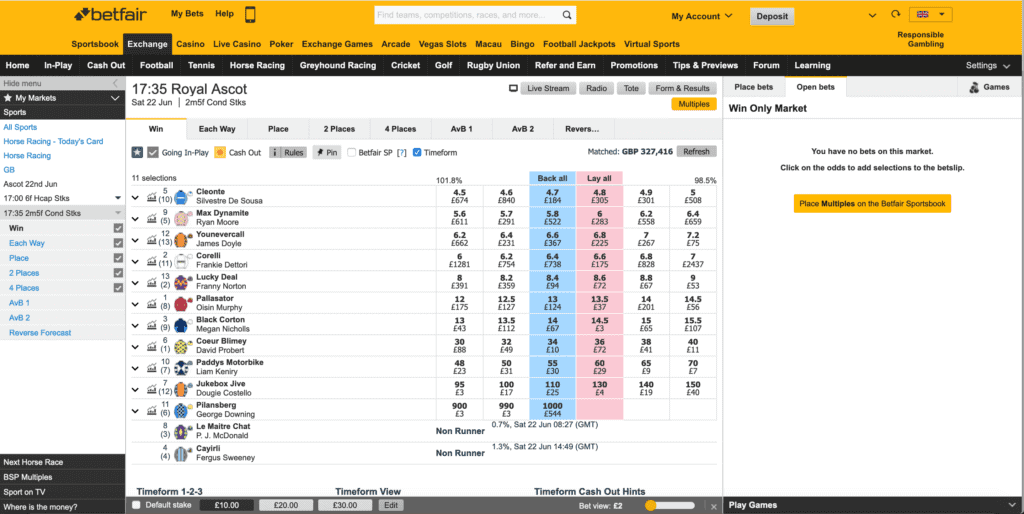
Example: You lay Cleonte at odds of 4.8 for £10. If Cleonte wins, you pay out £48 to the backer. If Cleonte loses, you keep their £10 stake.
Exchanges make money by taking a commission of 2%–5% on all winning bets, rather than building in an overround.
Commission v's Over-round
In a fair market, the implied probabilities of all outcomes add up to 100%. Bookmakers inflate this to build in profit. For example, adding up the implied probabilities across a William Hill horse racing market might total 128.1%. That 28.1% overround represents the bookmaker’s expected profit margin on every £1,000 wagered.
By contrast, the same race on Betfair might total just 101.5%. The odds available on the exchange are therefore usually higher — though any winnings are subject to commission.
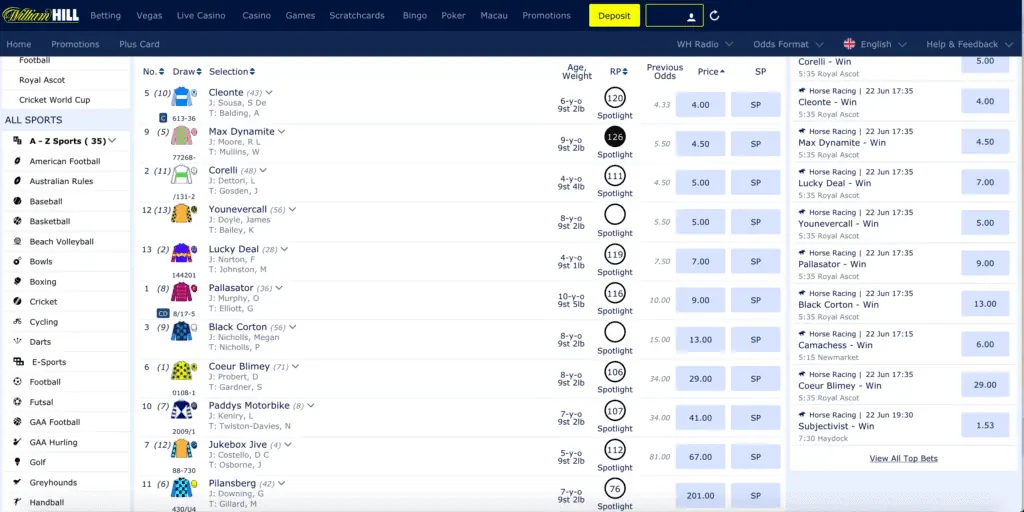
Example:
- £10 on Paddy’s Motorbike at William Hill (41/1) = £410 return
- £10 on the same horse at Betfair (55/1) = £550 return, minus 5% commission = £522.50
- Profit difference from the same horse, same race: £112.50
Account restrictions
Bookmakers use big wins in their marketing, but winning consistently puts you at risk of account restrictions. If a bookmaker’s algorithm identifies you as an unprofitable customer, they may:
- Limit the amount you can stake per bet
- Remove you from promotions and bonuses — you may still receive emails, but claims will be denied
- Close your account entirely in extreme cases
Each bookmaker uses an algorithm that scores each bet based on factors like stake size, odds compared to the market, and whether you win. The goal is to weed out sharp bettors who bet for value.
Exchanges take the opposite approach. They earn commission on every bet regardless of the result — so winning customers are welcome, and restrictions are rarely applied.
Betting Options
Multiples / ACCAs
If you want to bet on accumulators, you’ll need to use a bookmaker. Exchanges don’t support multiples because each leg would need to be matched by a separate user at the right odds. Bookmakers can multiply your selections and pay out at the combined accumulated odds.
Trading
Trading is one of the main advantages of exchange betting. The idea is to back and lay the same selection within the same market, locking in a profit regardless of the result by exploiting price movements.
Example: You back Chelsea to win at 3.0 for £10. They go 1-0 up and their odds shorten to 1.5. You then lay Chelsea for £20. If Chelsea win, your back bet profits £20, minus the £20 lay — breaking even. If Chelsea lose, your back bet loses £10, but your lay wins £20 — a £10 profit either way.
Trading is a deep topic with thousands of strategies, but the core principle mirrors stock market trading: buy low, sell high.
Singles
Singles can be placed with either a bookmaker or an exchange. The key is finding the best odds. Use comparison tools like Oddschecker or Betbrain to see who’s offering the best price across the market. Over time, even small differences in odds add up significantly.
Free Bets And Bonuses
Bookmakers rely heavily on free bets and promotions to attract and retain customers. Welcome bonuses are common across both bookmakers and exchanges, but ongoing promotions are almost exclusively a bookmaker tool.
The reason is competition. There are only a handful of major exchanges — Betfair, Smarkets, Matchbook, Betdaq — so they face far less pressure to compete on promotions. Bookmakers, by contrast, operate in a saturated market. With thousands of betting options and dozens of major operators, promotions are one of the few ways they differentiate themselves.
horse racing
Win Markets
A win bet backs a single horse to finish first in its race. Your total return includes your original stake — so a £50 bet at 3/1 returns £200 in total, not just £150 profit.
Most online bookmakers now offer Best Odds Guaranteed on horse racing. This means if you take a price early and the starting price is higher, you get paid at the bigger figure. It’s always worth taking the early price for this reason.
Ante Post Betting
Ante post markets open before final declarations, sometimes months before major races. The odds are generally higher than on race day, reflecting the uncertainty around whether your selection will actually run.
The earlier you commit, the better the odds available. However, non-runners are a real risk — and in most ante post markets, you lose your stake if your horse doesn’t start.
Exchanges can help manage this risk. If conditions change before race day, you can lay your selection on the exchange to recover some or all of your stake, regardless of whether it runs.
Cover Bets
Cover bets, also called full cover bets, allow you to bet across multiple horses in linked combinations.
- Double — two horses, both must win
- Treble — three horses, all must win
- Yankee — four horses, 11 bets (6 doubles, 4 trebles, 1 four-fold)
- Super Yankee — five horses, 26 bets
- Heinz — six horses, 57 bets
- Super Heinz — seven horses, 120 bets
- Goliath — eight horses, 247 bets
With a Yankee, for example, if two of your four horses win, you still collect on one of the six doubles. Remember that your unit stake multiplies across all bets — a £1 Yankee costs £11 in total.
The odds in a double multiply together. Back one horse at 3.0 and another at 4.0, and the combined odds are 11/1, because your winnings from the first ride on the second.
Betting Online
Online betting offers better odds, faster payouts, and far more markets than traditional shops. Payouts are typically instant — your returns appear in your account within minutes of the result.
Use odds comparison sites to find the best price before placing any bet. There’s no reason to accept poor value when better odds are available elsewhere at the click of a button.
Choosing A Racing Bet
Professional gamblers operate with clear rules. Here are the principles worth following:
- Know all available markets before deciding how to bet
- Always compare odds across bookmakers before placing
- Focus on value — if your selection doesn’t represent value, don’t bet
- Use a staking plan — bet 10% of your bank per selection. If your bank is £50, your first bet is £5. If it drops to £45, your next bet is £4.50. If it grows to £80, you bet £8
- Use a points system — rate confidence from 1–10 and bet proportionally. A 5/10 confidence rating at £5 per point means a £25 stake
- Stay patient — even professional gamblers accept a 40% strike rate, provided bets offer genuine value
getting value in horse racing
A 2/1 favourite looks attractive, but including a 5% overround, that price implies roughly a 35% chance of winning. In other words, 65% of 2/1 favourites get beaten.
If you rate a horse at a 1-in-3 chance, you need odds of at least 3.25 to have a positive expected return. If the best available price is 2.5, the bet doesn’t represent value — and the right call is to skip it.
Value is the foundation of profitable horse racing betting. Every professional bettor starts there.

ACCAs
What is an Accumulator/ACCA bet?
What Is an Accumulator?
An accumulator — or ACCA — combines two or more individual bets into a single wager. All selections must win for the bet to pay out. In return, the combined odds are far higher than placing each bet separately.
- Double — 2 selections
- Treble — 3 selections
- Four-fold and above — 4+ selections
The returns work progressively: if the first leg wins, the stake plus winnings roll onto the second leg, and so on.
High risk, high reward
More legs means higher potential returns — but also a lower probability of success. One losing leg forfeits the entire bet.
Example probability calculation: Four legs at odds of 3.2, 3.9, 1.47, and 3.45 give implied probabilities of:
- 100 ÷ 3.2 = 31.25%
- 100 ÷ 3.9 = 25.6%
- 100 ÷ 1.47 = 68%
- 100 ÷ 3.45 = 29%
Multiply these together: 31.25% × 25.6% × 68% × 29% = 1.58%
That’s the implied chance of all four coming in. However, as each leg wins, the probability of the remaining legs improves. If the first two win, the remaining two carry a combined probability of 68% × 29% = 19.8% — a much more manageable position.
ACCA Pitfalls to Avoid
- Check maximum payouts before building long ACCAs. A 15-leg bet is pointless if the bookmaker caps payouts at £150,000 when your potential return is £250,000.
- Watch for reduced odds — some bookmakers offer lower odds on ACCA selections than on equivalent singles. This erodes value over time.
- More legs, lower probability — bookmakers profit heavily from ACCAs precisely because most lose. Newsworthy big wins exist to encourage more people to try.
- Cash out offers are usually poor value — early settlement prices tend to undervalue your position when you’re ahead.
ACCA Insurance and Bonuses
Most major bookmakers offer ACCA insurance — your stake is refunded if one leg lets you down. However, check the terms carefully. Refunds are usually issued as free bets, minimum odds thresholds apply per leg, and maximum refund amounts are capped.
Winning ACCA bonuses are also common, with the bonus size increasing with the number of legs. Always check whether the bonus is paid on top of the maximum payout or counts toward it.
Cashing Out Your ACCA
If three of your four legs win, laying off the final leg on an exchange can lock in a guaranteed profit. You give up the chance of the full win, but protect against walking away empty-handed.
Successful bettors manage their positions actively rather than waiting passively for results. Timing matters too — spreading your ACCA legs across different kick-off times gives you opportunities to reassess and lay off between results.

Cashing Out
How Cash Out Works
Cash out lets you settle a bet before the event finishes. The bookmaker offers a guaranteed payout based on the current state of play. Accept it and you lock in that amount — win or lose from that point.
For example, if you stand to win £100, you might be offered an early cash out of £60. Taking it banks £60 regardless of the final result. If the bet would have won, you miss out on the extra £40. If it would have lost, you’ve saved £60.
Cash out is most commonly available on in-play bets, where the offer amount fluctuates as events unfold. Towards the end of a game, the cash out value can move rapidly.
Partial cash out
Partial cash out lets you settle a portion of your bet while leaving the rest active. For example, you could cash out 50% for an immediate return, with the remaining half riding on the final result. Some bookmakers, including Betfair, let you choose the exact percentage to cash out.
When to Take a Cash Out
There’s no universal rule — it depends on your position and your strategy. Consider cashing out when:
- You’re ahead and want to protect your profit
- The match situation has deteriorated and you want to limit losses
- You want to guarantee something rather than risk walking away with nothing
On the other hand, if your bet looks likely to win, holding out for the full return is usually more profitable than accepting a discounted cash out offer.
Whatever you decide, record your cash out decisions and review them. Over time, this builds a more intuitive sense of when cashing out adds value.
Why Cash Out May Be Unavailable
Several situations can prevent cash out:
- Incompatible market — cash out isn’t available on all sports or competitions. Obscure leagues and events are less likely to support it.
- Incompatible bet type — specials and build-your-own bets often don’t support cash out.
- Free bet restriction — cash out is usually unavailable on free bets, to prevent bettors from cashing out risk-free.
- Market volatility — after a goal or red card, cash out may be temporarily suspended while odds recalculate.
- Bet already lost — if there’s no remaining chance your bet can win, the cash out option disappears entirely.
Why Bookmakers Offer Cash Out
Cash out benefits the bookmaker as much as the bettor. It lets them reduce liabilities and close positions early, especially when one outcome becomes significantly more likely.
If a team scores, the true odds on them winning shorten considerably. By offering cash out at a discounted rate, the bookmaker reduces what they’d otherwise owe if that team goes on to win. Advanced algorithms calculate the optimal cash out price at every moment, ensuring the bookmaker maintains a statistical edge even through early settlement offers.
That said, cashing out can still be the right move for the individual bettor in the right situation. The key is understanding when the offer reflects genuine value — and when you’re simply being bought out cheaply.

sports glossary
A-C
Accumulator / ACCA — A multi-selection bet where all legs must win. Returns compound progressively across each leg, delivering much higher odds than individual bets.
Aces — A tennis betting market on which player serves the most aces in a match.
Across the Board — A horse racing bet backing a horse to win, place, and show simultaneously.
Also-Ran — Any selection that fails to win, place, or show. For example, a fifth-place finisher in a race.
Any To Come (ATC) — An instruction to automatically reinvest winnings from one bet into another.
Arbitrage / Arb — Exploiting odds discrepancies between bookmakers to guarantee a profit by backing all outcomes simultaneously.
Bad Beat — An unexpected loss on a bet that appeared to be winning. Common US terminology.
Banker — A selection considered near-certain to win. Often used as the foundation of an accumulator.
Betting Exchange — A platform where bettors wager directly against each other. One user backs, another lays, with the exchange taking a commission on winnings.
Book — The full set of a bookmaker’s positions on an event, including odds and profit calculations for each outcome.
Bookmaker / Bookie — The person or company accepting bets. Also called a turf accountant or sportsbook.
Buy Price — The odds at which you back a selection on an exchange. The opposite of the sell price. The gap between them is the spread.
Carpet — Informal UK term for odds of 3/1.
Cash Out — Early settlement of a bet at a live price, before the event concludes.
Chalk — US term for the outright favourite in a market.
Correct Score — A bet predicting the exact final score of an event.
D-H
Deposit — Money added to an online betting account.
Double — A two-selection bet. Both must win for a return.
Double Up — Increasing your stake after a loss to recover previous losses. The basis of the Martingale strategy.
Drift — When odds on an outcome lengthen over time, they are said to be drifting.
Each Way — A two-part bet: one on the selection to win, one on it to place. Common in horse racing.
Even Money — A 1:1 bet. Stake £10 and win £10 profit.
Favourite — The selection with the shortest odds in a given market.
Fold — The number of selections in an accumulator. A six-fold covers six selections.
Form — A competitor’s recent performance record, used to predict future outcomes.
Free Bet — A promotional bet offered by a bookmaker. You keep the winnings but not the stake.
French Odds — An older method of quoting odds in units of 100. Rarely used today.
Goliath — A full cover bet across eight selections, comprising 247 individual bets.
Grand — Slang for £1,000.
Half-Time Bet — A bet on the score or outcome at half-time, or on the second half in isolation.
Hedge — A second bet placed to offset losses if your primary bet fails. Bookmakers also hedge their own liabilities.
I-P
In the Money — A selection finishing in a paying position. In racing, typically the top four finishers.
Joint Favourite — Two competitors sharing the shortest odds in a market, with no clear favourite between them.
Lay — Betting on an outcome to fail, available on exchanges. You effectively become the bookmaker.
Live Bet — An in-play bet placed during a live event, with odds updating in real time.
Long Odds — Odds reflecting an unlikely outcome, offering the highest potential return.
Long Shot — An unlikely selection, ideally at long odds that reflect its true chances.
Martingale — A betting strategy based on doubling your stake after each loss.
Monkey — Slang for £500.
Odds — The price reflecting the likelihood of an outcome and the rate of return on a winning bet. Expressed as a fraction or decimal.
Odds-On — Any odds shorter than even money, such as 4/5 or 1/10.
Overlay — A selection with a better chance of winning than the odds suggest.
Patent — A seven-bet combination across three selections: three singles, three doubles, and one treble.
Picks — Selections recommended by pundits or tipsters.
Place — Finishing within a designated threshold short of winning. Paid at a fraction of win odds on an each way bet.
Punter — Informal term for a gambler.
R-Y
Roundabout — A combination bet across three selections, covering multiple bet types for enhanced odds.
Short Odds — Odds reflecting a likely outcome, offering a small return relative to the stake.
Shortening — When odds move closer to evens or below, reflecting increased market confidence.
Single — A standalone bet on one outcome.
Smart Money — Bets placed by those with perceived inside knowledge or superior analysis.
Spread — The gap between the buy and sell price on a betting exchange.
Spread Betting — A form of betting where winnings and losses are multiplied by the number of points above or below the market price. Results are proportional, not fixed.
Sure Thing — A selection considered almost certain to win. In practice, no bet is truly guaranteed.
Tip — A selection recommended as likely to win by a tipster or analyst.
Treble — A three-selection accumulator. All three must win for a return.
Trixie — A four-bet combination across three selections: three doubles and one treble.
Underdog — A selection considered unlikely to win, or a team given a points handicap in spread betting.
Value — A bet where the odds are higher than the true probability of the outcome suggests they should be.
Yankee — An 11-bet combination across four selections: six doubles, four trebles, and one four-fold.